

Three treatments get mixed up more than any others in cosmetic dentistry. A patient comes in asking about veneers when the tooth actually needs a crown. Someone else wants Invisalign to fix a color problem that braces-style movement cannot touch. The names sound interchangeable, so the prices get compared as if they were three quotes for the same job. They are not. Each one solves a different kind of problem, and picking the wrong one usually means paying twice.
This is a plain comparison of what each treatment does, what it costs at MD Dental in Fort Lauderdale, and where each one falls short. Sometimes the honest answer is the cheaper option. Sometimes it is none of the three, at least not yet.
Start with the problem, not the treatment
Chips and wear
A small chip on an otherwise healthy tooth is a shape problem. The tooth is strong, the root is fine, only the edge is missing. A veneer can work here because it replaces the visible front surface and rebuilds the outline. For a very small chip, bonding or simple reshaping may be enough, and it costs less than any of the three treatments in this article.
Wear is different. Teeth that are ground down flat, often from years of night grinding, have lost structure on every surface, not just the front. Covering only the front with a veneer leaves a weakened tooth behind it. Those teeth usually need crowns, which wrap the whole tooth, and the grinding itself has to be addressed or the new work wears the same way.
Discoloration
Stains from coffee, tea or smoking sit on the surface. Whitening handles those, and it is cheaper than everything discussed here. Deep stains are another story. Tetracycline staining, fluorosis, or a single tooth that darkened after an injury or a root canal will not respond fully to whitening because the color lives inside the tooth. A veneer masks it by covering the front with porcelain in a chosen shade, which is why veneers are often the practical answer for one stubborn dark tooth.
Invisalign does nothing for color. Moving a discolored tooth gives you a straighter discolored tooth.
Gaps and mild rotation
This is where Invisalign earns its price. Teeth that are healthy but badly positioned, a gap between the front teeth, one incisor rotated behind its neighbor, are position problems. Aligners move the actual teeth, gradually, and nothing gets drilled or covered. When the teeth themselves are well shaped and well colored, moving them is the least invasive fix there is.
Veneers can close small gaps too, by making two teeth slightly wider. That works, but it is a cosmetic shortcut: the gap is hidden, not corrected, and the teeth end up a bit broader than before. For a large gap or real crowding, veneers become a compromise that a good exam will talk you out of.
Uneven edges
A front tooth that is shorter than its partner, or edges worn at different heights, sits between categories. If the difference is small and the teeth are straight, veneers can rebuild the edges to match. If the unevenness comes from the bite, teeth meeting edge to edge or one tooth pushed forward, the bite has to be corrected first, which points back to aligners or a crown depending on how much tooth is left.
What each treatment actually involves
Veneers
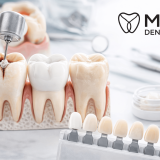
A veneer is a thin porcelain shell bonded to the front of a tooth. Preparation means removing a thin layer of enamel from that front surface so the shell sits flush. That enamel does not grow back, so veneers are a one-way decision: the tooth will always need a covering from then on. Treatment usually runs over two visits, preparation and impressions first, then bonding once the lab work returns. Feldspathic veneers are layered by hand, which gives a very natural translucency; E.max veneers are milled or pressed from a stronger ceramic. Maintenance is ordinary brushing, flossing and checkups, plus care with very hard foods on the front teeth.
Limitations worth knowing: veneers do not strengthen a weak tooth, they are not a good idea on teeth with large existing fillings, and heavy grinders can chip them. For the material and price detail in one place, our veneers in Fort Lauderdale page lays out E.max from $850 per tooth and hand-layered feldspathic from $1,200, and which cases each material suits.
Crowns
A crown covers the entire tooth, all the way around, down to the gumline. More tooth is reshaped than with a veneer, because the material needs room on every side. That is the trade for strength. A crown is the right tool when a tooth is cracked, heavily filled, worn down, or has had a root canal and needs protection. The process is similar in rhythm to veneers: preparation and a temporary first, the finished crown fitted at a second visit. A crown can absolutely be part of a cosmetic result, matched in shade to its neighbors, but its real job is structural. Putting crowns on healthy teeth purely for looks removes more tooth than the result justifies, and a careful dentist will say so.
Invisalign
Invisalign is a series of clear removable trays. Each tray shifts the teeth slightly, you change to the next tray on a schedule, and the teeth walk into place over the course of treatment. Nothing is shaved, bonded or drilled. The catch is discipline: trays need to stay in most of the day, every day, and come out for eating and drinking anything but water. Cases with significant bite problems, severely rotated teeth or teeth that need to move vertically may be beyond what aligners handle well, and that judgment comes from the exam and the scan, not from a photo. Maintenance during treatment is mostly about keeping trays and teeth clean; after treatment, a retainer holds the result, and skipping the retainer lets teeth drift back.
The prices, side by side, with what each one covers
These numbers are not three prices for one job. They buy different things, and comparing the totals directly is the most common mistake people make.
- E.max veneers: from $850 per tooth. The price covers one veneer on one tooth. Treating the four front teeth means four veneers. Feldspathic veneers, layered by hand, start at $1,200 per tooth.
- Crown: $800. The price is per tooth. What the figure includes beyond the crown itself is spelled out in the written estimate you get after the exam.
- Invisalign: $3,480. The price covers a full clear-aligner course, all the trays in the plan, not a per-tooth charge.
So $850 against $3,480 is not a bargain against a rip-off. One is a per-tooth cosmetic shell, the other is a full course of tooth movement. A patient who needs six veneers is looking at a very different total than a patient who needs two, and the aligner patient is buying repositioning that no veneer can do at any price. You can read more about how the practice structures treatment costs on the cost and financing page.
Three situations, three different answers
Say the two front teeth are healthy and strong, but one has a corner chipped off and there is a small gap between them. Veneers are a reasonable answer: two shells rebuild the corner and widen both teeth slightly to close the gap. Aligners would close the gap too, but they cannot rebuild the missing corner.
Take a back molar with an old, large filling and a crack running into it. No veneer belongs there. The tooth needs a crown to hold it together, and cosmetics are beside the point until the tooth is safe. Doing anything prettier first risks losing the tooth.
Now picture front teeth that are crowded, one overlapping the other, with good color and no damage. Veneers here would mean shaving down healthy teeth and building porcelain shapes to fake alignment. Invisalign is the honest recommendation. It takes longer, and it asks more of the patient day to day, but the teeth stay whole.
Notice what decided each case. Not the budget, not the brochure. The condition of the teeth.
When the answer is “not yet”
A few findings pause all three treatments. Untreated gum disease undermines everything built on top of it, because veneers, crowns and moved teeth all depend on healthy gums and bone. Active decay has to be cleaned out and restored before any cosmetic work is planned. A bite problem causing heavy wear will damage new porcelain the same way it damaged the original teeth. None of this is a sales delay tactic. It is sequencing, and any written plan you receive should show the order plainly: health first, structure second, appearance last. The broader picture of what the practice handles is on the cosmetic dentistry services page.
Questions to bring to your assessment
- Which problem are we actually fixing: shape, color, position, or strength?
- How much of my own tooth gets removed for each option you are suggesting?
- If we do the cheaper option now, what would make it fail, and what would redoing it cost me?
- What does each price include, in writing, and what is not included?
- What maintenance am I signing up for, and what happens if I skip the retainer or the checkups?
- If we do nothing for a year, what changes?
Where to start
If you are weighing these three options, the useful first step is an exam with a scan, so the recommendation is based on the condition of your teeth rather than on photos or guesswork. You can look at examples of the work itself on the veneers page, read about Invisalign treatment, and book a consultation with MD Dental in Fort Lauderdale to get a written plan with exact figures for your case.